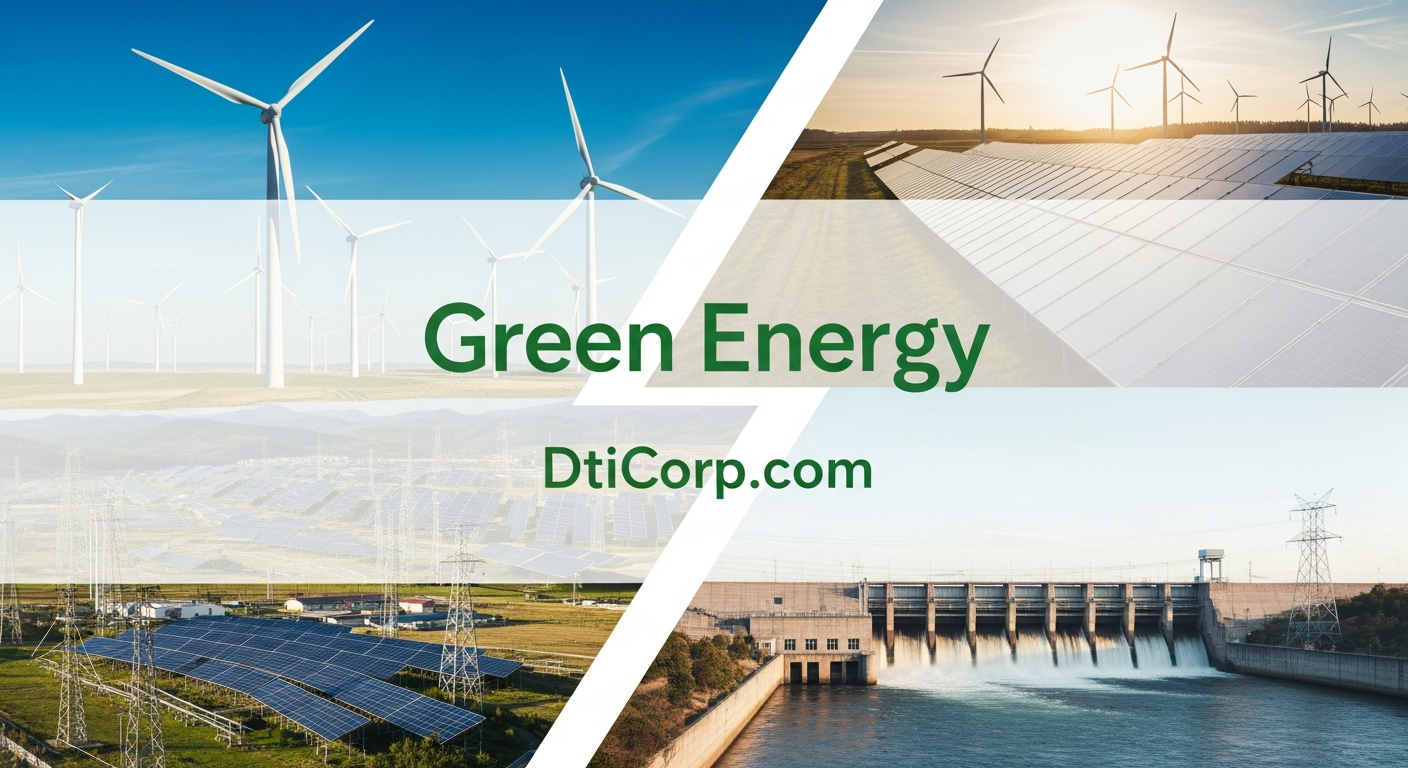
The energy industry is the largest producer of carbon dioxide (CO2) emissions, contributing approximately 80 percent (source: https://www.iea.org/reports/global-energy-review-2025/co2-emissions). Air pollution in the United States continues to have a profoundly negative effect on the environment and human health. As a consumer you may have a choice, a choice to purchase reliable green power to help reduce this toxic pollution to create a sustainable environment for future generations.
As the utility industry deregulates, you may be overwhelmed with the various “offers” from numerous electric service providers. To assist you in distinguishing the value of a ‘green power’ offer, we have answered the following questions:
Green power is a term used to describe electricity generated from renewable resources, such as solar, wind, geothermal, small hydro, and biomass, which have the least amount of environmental impact. These “environmentally friendly” resources, provide the consumer an alternative means to conventional electricity generated from coal, nuclear power, natural gas, oil, and large-scale hydro plants. Currently, coal power plants produce the largest share of the world’s energy needs. However, this inexpensive method causes the most damage to the environment in the form of toxic emissions. These toxic emissions, sulfur dioxide and nitrogen oxides, combined with water cause acid rain and attribute to global warming.
Solar
The sun provides an endless supply of energy daily. Solar energy uses the sun’s radiation to produce electricity in two ways, solar thermal and photovoltaic (PV) applications. Solar thermal is a collection of the sun’s radiant energy to produce heat, generally for water heating. Photovoltaic systems convert the sunlight to electricity through the use of photovoltaic cells or modules. This technology introduced in the early 1970’s for the US space program has decreased significantly in cost from approximately $300 to about $4 per watt. Photovoltaic systems are typically used in rural settings were the cost of connecting to the “grid” are too costly. Although every location on Earth receives sunlight, the amount received varies greatly depending on geographical location, time of day, season and clouds. The southwestern United States is one of the world’s best areas for sunlight. This desert region receives almost twice the sunlight as other regions in the United States.
Wind
This form of clean renewable energy, which emits no air pollution, is produced using wind turbines or windmills to create electricity. The U.S. currently has nearly 160,000 megawatts (MW) of installed wind capacity and in 2025 U.S. wind power generated 464 billion kilowatt-hours (kWh) – source: https://www.eia.gov/todayinenergy/detail.php?id=67367.
Three of the largest wind farms are located in southern and central California. The wind energy produced in California provides residents millions of kilowatt-hours of electricity every year. The nation’s largest turbine in Michigan, consisting only of propellers, a gearbox, and a generator, saves 600 tons of coal a year. Wind farms can generate electricity for as low as 4¢ to 7¢ per kilowatt-hour.
Geothermal
Deep beneath the earth’s surface, hot magma heats the underlying water or steam converting it to electricity. Geothermal resources vary in temperature. Low-to moderate temperature (20°C to 150°C) geothermal resources are used to provide direct heat for homes and industry, while the high temperature (above 150°C) geothermal resources are used in electric power generation. Geothermal plants are very economical and have minimal environmental impacts as well as produce only one-sixth of the carbon dioxide that a natural gas fueled electrical generating power plant produces. The cost of geothermal energy varies; it can be as low as $0.015 to 3.5 cents per kilowatt-hour.
As of early 2026, here is the current status of geothermal energy in the United States (source: https://www.nlr.gov/geothermal/2025-us-geothermal-market-report):
– Installed Capacity: The U.S. currently has approximately 3,969 megawatts (MW) of installed nameplate capacity as of 2024. This is significantly higher than the 1,600 MW mentioned in your query.
– Annual Electricity Production: In 2023, geothermal plants in the U.S. produced about 16.4 to 17 billion kilowatt-hours (kWh) of electricity. Your figure of 3 billion kWh is much lower than actual current production levels.
– Net Generation Capacity: The “net” operable capacity—which accounts for actual power delivery to the grid rather than the theoretical maximum (nameplate)—was reported at approximately 2,700 MW at the end of 2024.
Biomass
Biomass plants burn organic material, such as waste, wood and agricultural and animal waste to produce energy. This clean, renewable, and indigenous energy uses two methods to convert biomass to electricity. Solid biomass fuels are burned in a broiler. The fuel turns to steam which is then used to turn a turbine generator to produce electricity. The second method involves gasifying the fuels to be burned and used as electricity. As of 2024, solid biomass electricity generation capacity in the United States reached 8,931 MW (source: https://www.statista.com/statistics/183429/biopower-generation-by-source-in-the-united-states-from-2000/) – enough power to meet the energy needs of several million households. Today, various forms of biomass energy account for nearly 4 percent of all energy consumed in the US and 45 percent of renewable energy used in the US.
Small-scale Hydro
Transforming the energy of falling water by using hydraulic turbines generates hydroelectric power. Hydroelectric power is classified as either large-scale or small-scale. Small-scale hydro differs significantly from large-scale hydro in terms of its environmental impacts. Large-scale hydro plants require the construction of dams and reservoir tanks. Large-scale hydro impacts its surrounding environment by restricting the water flow through the use of a dam, thus restricting the fish flow, wildlife, and affecting the entire ecosystem. Small-scale hydro facilities are positioned by rivers or canals causing less of an environmental impact on the surrounding ecosystem. Hydroelectric plants less than 30 megawatts (MW) in size are considered small-scale hydro and qualify as a renewable resource. Rapidly moving water is directed through tunnels to rotate turbines, creating mechanical energy. This energy is converted to electric energy by a generator. Unlike other energy sources such as fossil fuels, water is not destroyed during the production of electricity-it can be reused for other purposes.
How can I make sure the power is really green?
As a consumer, you may be concerned about how to identify real green power products. As the utility industry begins to restructure, numerous suppliers label their product mix ‘green.’ Since no clear definition exists for green power, environmentalists are concerned that consumers will receive inaccurate or fraudulent information. In California, suppliers are now required to label their power to inform consumers which energy resources are used to generate power. As a consumer, verify with your electricity supplier what energy resources are being used. If the supplier will not provide this information, then be cautious about the validity of the claim that the product is green.
Energy Resources: A list of the various energy resources used to generate electricity is provided for consumers. The energy resources are categorized as eligible renewable and non-renewable resources.
Product: The electric service provider is required to provide a percentage breakdown the power by energy resource for each offer. In the example, 55 percent comes from renewable resources. The actual resource mix is not provided in this example, however, if you purchased this product the electric service provider would be required to provide the detailed information at the end of the year.
How much does green power cost?
The cost of electricity generated from renewable resources such as solar and wind can be higher than the cost of electricity generated by traditional inexpensive methods like coal. When purchasing a green power product, your dollars are going towards the technology it takes to produce the energy. For example, if you select a 100% renewable product with 50% solar and 50% wind, then you are paying a solar and wind plant to generate the electricity and feed it into the main power grid. As demand for green power increases, more cost-effective methods for renewable generation will be built resulting in a lower cost for consumers.
Will Green power come straight to my home?
No. The electricity supplied to your home is part of the power grid. The grid combines all power sources in a regional pool, so there is no way to separate the electricity generated from renewable sources and non-renewable sources. In selecting a green offer, the supplier is indicating that they are purchasing their electricity from renewable energy sources. When you purchase green power you are sending a message to electricity providers that they should purchase electricity from renewable resources.
I noticed that some products are Green-e certified, what does this mean?
The Green-e logo easily identifies for consumers electricity products that are generated from at least 50% renewable energy resources. This voluntary certification program was created by the nonprofit Center for Resource Solutions.
When you see the Green-e logo on an electricity product, you can be sure:
- at least 50% of the electricity supply for the product comes from renewable electricity resources, such as solar, water, wind, biomass, geothermal.
- any non-renewable part of the product has lower air emissions than your traditional mix of electricity would have if you did not switch.
- the company offering the product agrees to abide by the Green-e Program’s Code of Conduct, which requires that providers disclose the sources of your electricity.